Can You Go Inside Ostrog Monastery?
Yes, you can go inside Ostrog Monastery: entry is free, the caves are open daily year-round, and the only real gatekeepers are the dress code and the climb. Here is how visiting works.
Can You Go Inside Ostrog Monastery?
Yes, you can go inside Ostrog Monastery. Entry is free of charge and the monastery complex is open to visitors daily, all year round, with approximate hours of 06:00 to 17:00 from May to September and 05:00 to 16:00 from October to April. The only conditions are a modest dress code covering shoulders and knees, and the physical effort of reaching the Upper Monastery itself.
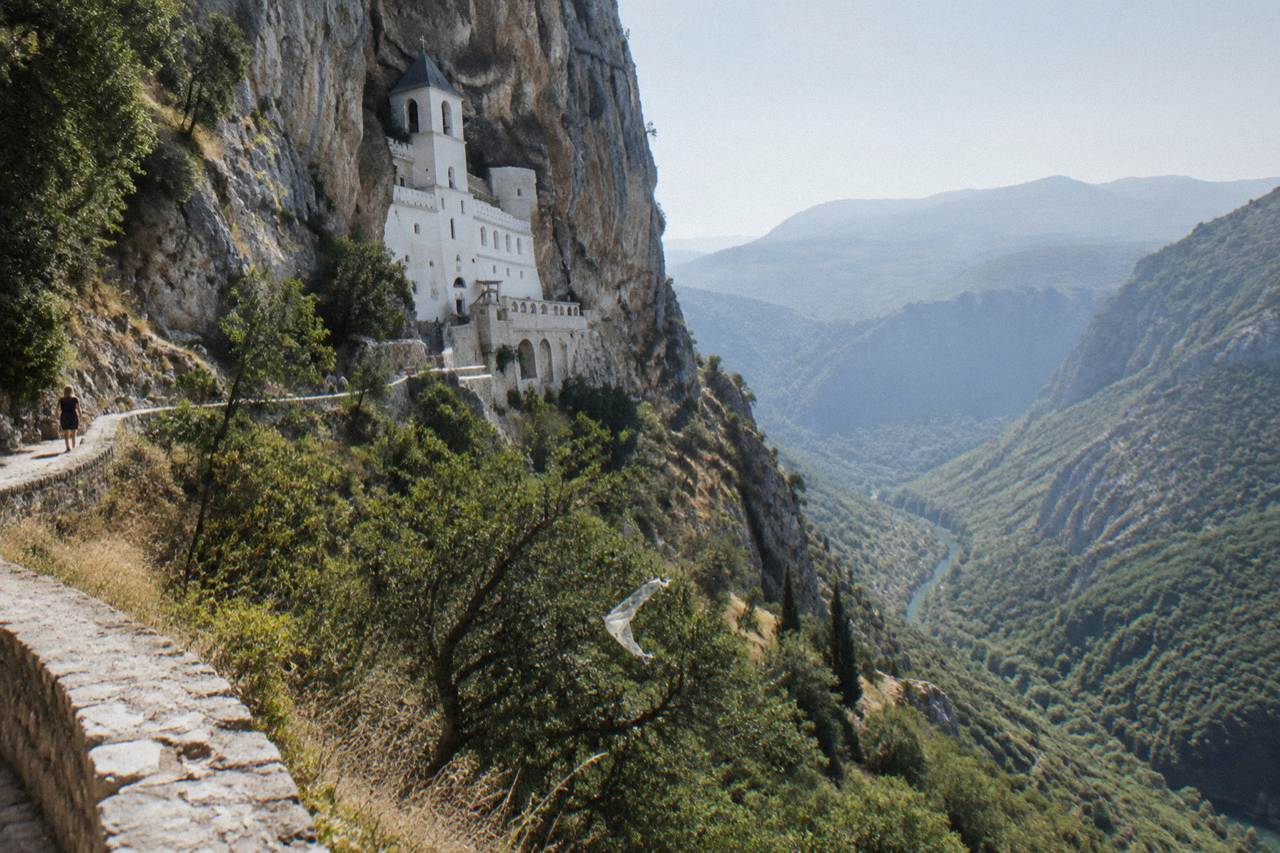
That single answer surprises people who have only seen photographs. The monastery looks inaccessible, a whitewashed cluster of buildings pressed into a rock face so sheer it seems to defy construction, let alone tourism. In practice Ostrog is one of the most open religious sites in the Balkans. Pilgrims, casual visitors and tour groups share the same corridors, the same caves and the same viewpoints, and nobody charges admission at the door.
The monastery sits above the village of Danilovgrad, roughly an hour by road from Podgorica and around 40 minutes from Niksic. It is a Serbian Orthodox monastery dedicated to Saint Basil of Ostrog, whose remains rest in a reliquary inside the Upper Monastery, and it draws a mix of Orthodox pilgrims, Catholic and Muslim visitors and non-religious travellers. That mix is worth understanding before you arrive, because it shapes the atmosphere. This is a working place of worship first and a sight second, and the visiting rules reflect that. Whether that atmosphere suits your plans depends on what you hope to get from the trip, so our verdict on whether Ostrog Monastery deserves a stop on your itinerary can help you decide.
For most coastal visitors the practical question is not whether entry is possible but how to fold a two-to-three-hour detour inland into a holiday based in Kotor, Budva or Herceg Novi. The site's own pages and the monastery's published details cover the rules; this article gathers them in one place and connects them to the tour options that include the monastery, starting with the trio below.
What Are The Visiting Rules At Ostrog Monastery?
The rules are simple and strictly applied: entry is free with voluntary donations customary, shoulders and knees must be covered for everyone, and the monastery keeps roughly 06:00 to 17:00 hours in summer and 05:00 to 16:00 in winter, every day of the year. Wraps are sometimes available at the Upper Monastery entrance if you arrive underdressed. The dress expectations are a code, not a suggestion, and staff and monks do turn away visitors in shorts or sleeveless tops.
The specifics come from the monastery's own information and consistent recent practice. Long trousers or skirts are the safe choice, no shorts and no sleeveless tops, with head coverings optional for women rather than required. A light scarf or sarong weighs nothing in a daypack and solves the problem entirely; if you forget one, wraps are sometimes handed out at the entrance to the Upper Monastery, though you should not count on a supply during busy periods.
Photography is tolerated in the open areas but behaves the same way as dress: read the room. The cave chapels are small, dim and often full of people praying, which makes tripods, flash and posed photo sessions obviously wrong. Quiet conversation, no loud phone calls, and a readiness to step aside when a pilgrim wants to reach the reliquary are the behaviours that matter. Visitors who treat the upper caves as a viewing gallery rather than a church will feel the disapproval without anyone saying a word.
Donations deserve a word because the mechanics confuse people. There is no ticket desk and no requested amount. Donation boxes sit inside the monastery, and contributions fund maintenance and the pilgrim facilities. Giving is voluntary, a few euros is a normal gesture, and nobody monitors who gives what. The same free-entry principle applies regardless of whether you arrive independently, with a private driver or on a coach tour; no tour operator pays an admission fee on your behalf, because there is no admission fee to pay.
One practical note on timing your arrival: the monastery opens at dawn, and the rule of thumb repeated across recent visitor accounts is that weekday mornings are the calmest window, while weekends and the days around the feast of St Basil on 12 May bring crowds large enough to slow your visit considerably. Our Ostrog Monastery dress code and visiting rules guide covers the clothing question in more depth if you want the full checklist.
Can Ostrog be comfortably combined with the rest of a Montenegro itinerary? For many travellers the answer is a guided day trip that pairs the monastery with the northern mountains, which removes the need to think about parking, timing or the winding final road. The Durmitor, Tara and Ostrog day trip from Kotor, a 13-hour tour from $120 per person rated 4.7 from 2,645 reviews, is the best-known version, and you can Check availability alongside the full Durmitor and Tara day trip guide.
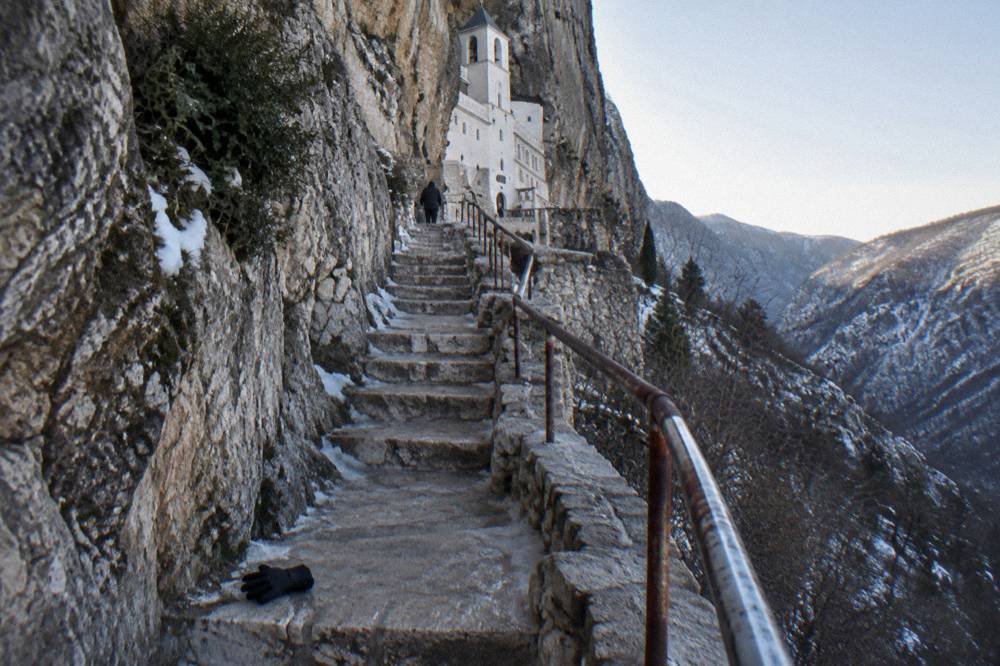
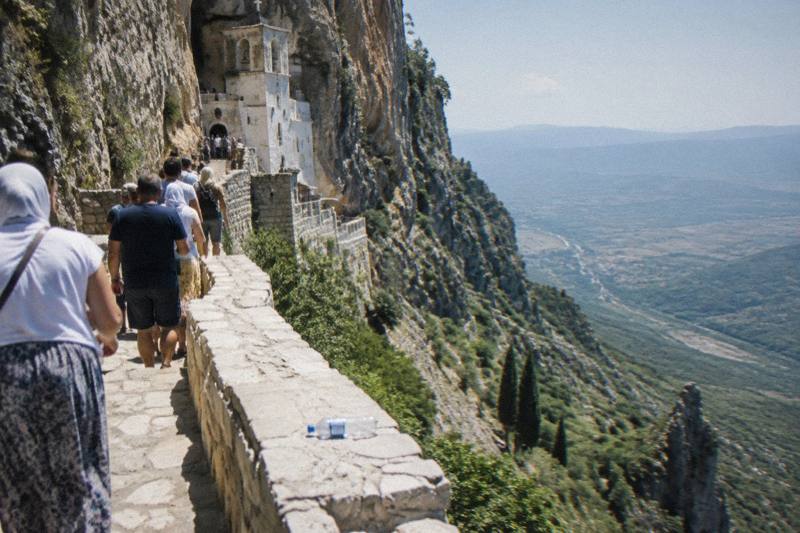
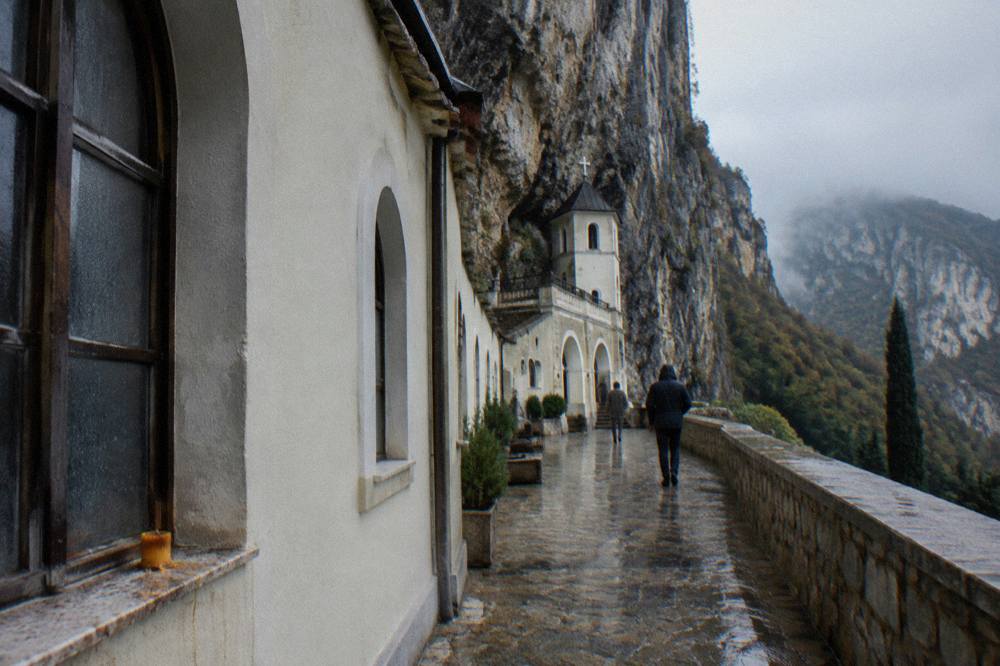
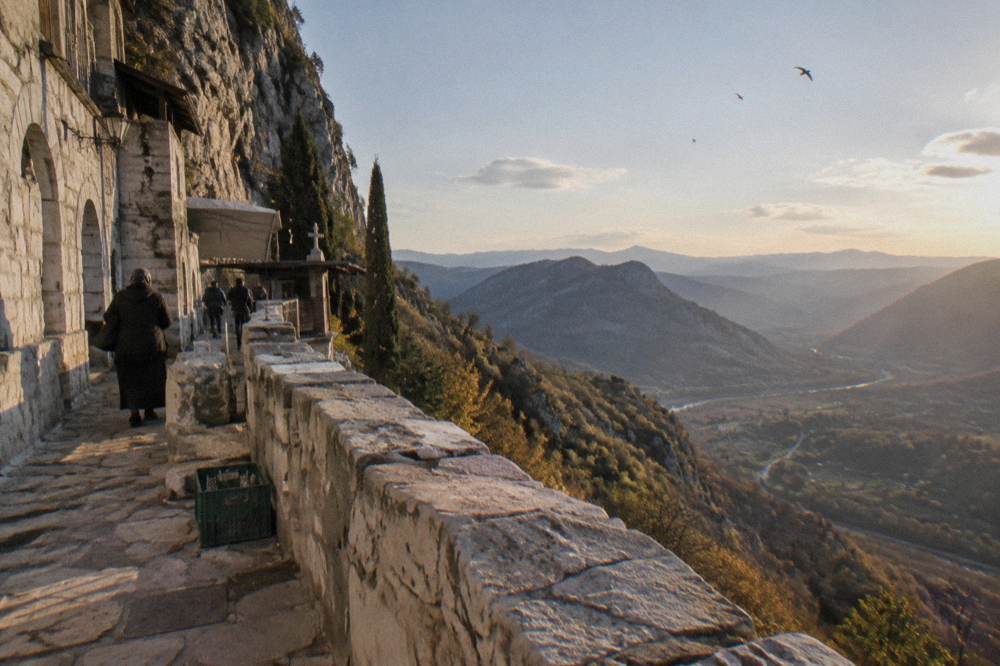
Here is how a visit works in practice, from the Lower Monastery at the base to the Upper, built into the cliff face. The complex has two parts, the Lower Monastery near the parking area, centred on the Church of the Holy Trinity, and the Upper Monastery, the famous cliff-carved section containing the Cave Church of the Holy Cross and the Cave Church of the Presentation, where St Basil's remains are kept. Visitors drive or walk between the two. The lower section is level and easy; the upper section involves a steep access road or a stone path, plus stairs inside the caves, so anyone with limited mobility will find the highlight of the visit the hardest part to reach. Parking at the Lower Monastery is free, while the small upper parking area fills quickly in season.
What Should You Wear To Visit Ostrog Monastery?
Wear clothing that covers your shoulders and knees, in practice long trousers or a long skirt and a top with sleeves, plus comfortable shoes for the climb to the Upper Monastery. The dress code applies to men and women alike, head coverings for women are optional, and wraps are sometimes available at the entrance but are not guaranteed.
This is the rule that most often interrupts a visit. Ostrog sits inland from the coast, and many visitors arrive straight from a beach base in Budva or Kotor wearing exactly what the coast encourages: shorts, singlets, sandals. The monastery does not run a hire service for modest clothing, so a party of four in beachwear can find itself choosing between a scramble for improvised coverings or waiting in the car park.
The fix costs nothing. Keep a pair of light trousers or a long skirt and a shirt with sleeves in the vehicle or daypack, and change at the Lower Monastery before heading up. Shoes matter almost as much as fabric: the approach to the Upper Monastery is steep, the stone path can be polished and slick, and the cave interiors involve a short flight of stairs. Flat shoes with grip beat flip-flops by a wide margin.
Weather plays a role in wardrobe planning too, and it is often underestimated. The monastery stands at serious altitude relative to the coast, and the drive climbs through the Zeta valley into noticeably cooler air. On a summer afternoon in Budva the monastery can feel ten degrees cooler in the wind on the exposed terrace, and in shoulder seasons a layer is worth having. There is a limit to how much weather can be promised either way, so bring the layer rather than trusting the forecast.
| Item | Rule or recommendation | Notes |
|---|---|---|
| Shoulders | Must be covered | Applies to all visitors, no exceptions |
| Knees | Must be covered | Long trousers or skirts; no shorts |
| Head covering | Optional for women | Wraps sometimes available at the entrance |
| Footwear | Sturdy flat shoes | Steep path and interior stairs |
| Extra layer | Recommended | Cooler and windier than the coast |
| Donation | Voluntary | A few euros in the boxes is customary |
How Much Time Do You Need At Ostrog Monastery?
Plan on one to two hours at the monastery itself, plus travel time. Seeing both the Lower Monastery and the cliff-carved Upper Monastery, waiting through any queue at the relic chapel and pausing at the viewpoints fits comfortably inside two hours. Most independent visitors spend about 90 minutes on site before the drive onward.
The breakdown is fairly predictable. The Lower Monastery, with its church, bell tower, pilgrim accommodation buildings and fountain, takes 15 to 20 minutes at a relaxed pace. The trip up to the Upper Monastery, by the access road or the pedestrian path, adds another 10 to 20 minutes depending on how you travel and how often you stop to photograph the cliff face, which is often, because the view back down the valley is the best angle on the complex itself.
Inside the upper caves, the pace is set by the crowd. The Cave Church of the Holy Cross is a compact space where visitors file through, and when a coach group is present the flow slows to a shuffle. Visitors who arrive at the same time as two or three tour buses should expect the upper section alone to eat half an hour. Arrive outside those windows and the same space can feel almost private, which is why the timing question and the transport question are really the same question.
Add context time if you want it. There is a small shop area near the lower complex where religious items, icons and postcards are sold, and the terrace by the Upper Monastery entrance is where most visitors absorb the setting. If your day is a loop from the coast, the honest total is a half-day commitment door to door from Budva or Kotor, or a full day if Ostrog is one stop of several.
The dedicated Ostrog Monastery tour with pickup, a four-hour trip from Podgorica from $136 per person, rated 4.9 from a small pool of 37 reviews, exists precisely for travellers based in or near the capital who want the monastery handled in half a day rather than stretched into a full northern loop.
Is Ostrog Monastery Hard To Reach?
Ostrog is reachable by any normal car, with free parking at the Lower Monastery and a steep final access road to the upper section, but there is no direct public bus service. Most visitors drive, take a taxi from Niksic or Podgorica, or join an organized tour; expect roughly 40 minutes from Niksic and about an hour from Podgorica by road.
The drive itself is the standard Montenegrin inland experience: a main valley road, then a signed climb on switchbacks to the monastery. The road is paved and passable for ordinary vehicles, and hire cars manage it daily in large numbers. What surprises some drivers is the last stretch and the parking arrangement. The lower parking is free and reasonably sized, but the upper parking is small and fills early in peak periods, at which point the walk up from the lower area becomes part of the visit whether you planned it or not.
Public transport is the weak link. No direct bus serves the monastery, a point consistent across recent guidance, so travellers without a car choose between a taxi from Niksic or Podgorica, a private transfer, or a day tour that includes Ostrog in its route. A taxi works well for a short, monastery-only visit; a tour earns its keep when Ostrog is one of several things you want in a single day, since the monastery sits on a natural corridor toward Durmitor, the Tara Canyon and the northern highlands.
That geography explains the tour market around Ostrog better than any marketing pitch. From the coast, the monastery is an inland detour; from Podgorica, it is close; and from any itinerary that also wants the mountains, it is conveniently on the way. Operators such as Gray Line Montenegro and 360Monte have built their flagship 13-hour northern day trips around exactly this chain, and the pairing works because the monastery visit is short relative to the driving.
Can You Stay Overnight At Ostrog Monastery?
Yes, but not as a tourist in a hotel. The monastery offers overnight pilgrim accommodation, known as the konak, on a donation or low-fee basis of around 5 euros, in simple segregated dormitories at both the Lower and Upper sites. Places are first-come in practice, and arriving early matters in the busy season.
The konak tradition is old and deliberately uncommercial. There are no bookings in the hotel sense, no private rooms for standard visitors and no on-site restaurant trade. What exists is shelter for pilgrims: bare dormitories, shared facilities and the chance to attend services through the night, which is the entire point for the Orthodox faithful who travel here, especially around feast days. Travellers who arrive with that framing, modest expectations and an interest in the religious life of the place report it as one of the more memorable nights available in Montenegro. The rest of the planning pages sit on Montenegro Tours.
Travellers who want comfort should not stretch the category. The nearest full-service accommodation is in Danilovgrad or Niksic, both within an easy drive, and most visitors treat Ostrog as a day stop rather than a base. The monastery's own contact details, published on its active site, are the route for anyone seriously considering the konak, since availability and conditions vary with the religious calendar more than with the tourist one.
The feast-day dimension deserves emphasis because it cuts both ways. Around 12 May, the feast of St Basil, the monastery fills with pilgrims, some of whom, as the walking groups from Herceg Novi have done for five years running, cover the distance on foot over three days. For a visitor interested in Orthodox practice this is the most vivid time to be there. For a visitor mainly interested in photographs and a quiet look inside, it is the worst possible date, and a weekday morning a month either side is the better plan.
Should You Visit Ostrog On A Tour Or On Your Own?
Independent visiting suits confident drivers and anyone based in Podgorica or Niksic, where the monastery is a short hop. A tour suits coastal visitors, since the drive from Kotor or Budva is long enough that pairing Ostrog with the northern highlights turns dead time into the best of the day. Both routes get you inside; the choice is about driving, not access.
The comparison comes down to geography and appetite for mountain roads. An independent visitor with a car controls their own clock: arrive early, stay an hour, leave when the coaches pull in. That flexibility is the independent route's whole advantage, and for a Podgorica base it is hard to beat, since the monastery is under an hour away and a half-day trip is realistic.
For coastal visitors the arithmetic changes. From Kotor or Budva the monastery is a serious outbound drive, and the question becomes what else fills the day. The north of Montenegro answers loudly: Durmitor National Park, the Tara Canyon and the monastery sit on a natural loop that guided tours have packaged into single 13-hour days. The Durmitor and Ostrog tour with pickup from Kotor, from $119 per person and rated 4.8 from 479 reviews, and the Durmitor, Tara and Ostrog day trip at $120 rated 4.7 from 2,645 reviews, both run exactly this shape, and each pairs a monastery stop with mountain scenery that would otherwise cost you a second travel day.
| Option | Best for | Typical shape | Rough cost driver |
|---|---|---|---|
| Own car | Podgorica or Niksic bases, flexible days | Half day, early start | Hire car and fuel |
| Taxi return | Car-free short visits | 2 to 3 hours on site | Metered or agreed fare |
| Dedicated Ostrog tour | Podgorica visitors wanting a guide | 4 hours with pickup | From $136 per person |
| Northern day trip tour | Coastal bases, first mountain day | 13 hours, Ostrog plus Durmitor and Tara | From $119 to $120 per person |
The pickup question matters here and is worth stating plainly: whether a specific tour collects you from your hotel varies by listing, and the roster shows pickup offered on the 360Monte and Fine-Car monastery tours but not verified on the Gray Line trip, which departs Kotor. Check the listing for each product rather than assuming either way.
What Is The Best Time Of Day To Visit Ostrog Monastery?
Early morning on a weekday is the calmest window: the monastery opens at 06:00 in summer, tour coaches concentrate in the late morning and early afternoon, and the hours just after opening offer the shortest queues at the Upper Monastery caves and the softest light on the cliff face. Late afternoon is the second-best choice.
The pattern is standard for a site served by coach tours. Buses from the coast and the capital arrive from mid-morning onward, and by early afternoon the upper caves run at their slowest, with visitor flow metered by the narrow chapel doorways. Anyone who can be on the path up shortly after opening will share the complex mainly with pilgrims and a handful of independent travellers, and the difference in atmosphere is significant: the cave churches are at their most affecting when they are quiet.
Season shifts the calculation at the margins but does not overturn it. In the May-to-September window the long daylight lets an 07:00 arrival feel almost private, and the terrace heat builds toward midday, which the exposed upper sections absorb readily. From October to April the monastery opens an hour earlier and closes an hour earlier, crowds thin dramatically, and the trade-off is cooler air and a chance of mountain weather on the access road, for which the layer-and-grip advice in the wardrobe section applies double.
Feast days are the exception that overwhelms every rule. Around 12 May the monastery belongs to the pilgrims, and the walking groups, night services and dense crowds make a casual visit a different enterprise entirely. If your dates are flexible and you are not coming specifically for the religious life of the site, aim for a weekday morning outside that window and you will see the monastery at its most open.
Is Ostrog Monastery Worth The Detour?
For most travellers, yes. The interior caves, the reliquary of St Basil and the sheer audacity of the cliff-side architecture deliver more than the photographs suggest, entry is free, and the visit costs half a day from Podgorica or a well-packaged segment of a northern day trip from the coast. The main exception is the visitor with no interest in religious sites and no plan to continue north.
Worth is subjective, but the honest case for Ostrog rests on two things. First, the setting is genuinely unusual: the Upper Monastery is not a building near a cliff but a set of chambers carved into the cliff itself, and standing inside a cave church whose outer wall is rock changes the feel of the space. Second, the site works as a cross-section of Montenegro that the coast cannot offer: an active Orthodox monastery, inland valley scenery and a road into the mountains, all in one stop.
The honest case against is shorter but real. If you dislike crowds at reflective places, a midday arrival will test you. If your mobility is limited, the upper section's steep path and stairs will limit what you can see. And if your entire trip is three coastal days with no car, the travel time to reach Ostrog and back may outweigh the reward, in which case the bay's own options, from the best day trips from Kotor to the walls and old towns described in our things to do in Kotor guide, give a better return per hour.
For everyone in between, the monastery earns its place on the shortlist. It is one of the few headline sights in the country that costs nothing to enter, one of the few whose rules are simple enough to fit in a sentence, and, as this article's premise confirms, one of the few whose answer to the question "can you go inside?" is an unqualified yes.
Common Questions About Visiting Ostrog Monastery
Can You Go Inside Ostrog Monastery?
Yes. Entry is free, the complex is open daily year-round at approximate hours of 06:00 to 17:00 from May to September and 05:00 to 16:00 from October to April, and the only conditions are modest dress covering shoulders and knees and the walk up to the cliff-carved Upper Monastery.
Is Ostrog Monastery Free To Enter?
Yes. There is no admission charge and no ticket desk. Voluntary donations are customary, with boxes inside the monastery; a few euros is a normal contribution. Tour operators do not pay an entry fee on your behalf, because none exists.
What Is The Dress Code At Ostrog Monastery?
Shoulders and knees must be covered for all visitors: long trousers or skirts, no shorts, no sleeveless tops. Head coverings for women are optional. Wraps are sometimes available at the Upper Monastery entrance, but bring your own to be safe.
How Do I Get To Ostrog Monastery Without A Car?
There is no direct public bus. Options are a taxi from Niksic (about 40 minutes) or Podgorica (about an hour), a private transfer, or an organized tour. The dedicated four-hour monastery tour from Podgorica, from $136 per person, is the most direct guided option.
Can You Stay Overnight At Ostrog Monastery?
Yes, as a pilgrim. The konak offers simple segregated dormitory accommodation on a donation or low-fee basis of around 5 euros, first-come in practice. It is not hotel-style lodging; comfortable accommodation is in Danilovgrad or Niksic.
When Is Ostrog Monastery Most Crowded?
Late morning to early afternoon, when coach tours concentrate, and around the feast of St Basil on 12 May, when pilgrims fill the site. Early weekday mornings are the calmest window for a quiet visit to the cave churches.